
Galvanized or painted steel gratings are common in industry, but their rapid corrosion in harsh environments weakens the structure and necessitates frequent replacements. Their electrical conductivity increases the risk of accidents, while their weight complicates installation and overloads the supports. Finally, their surface becomes slippery when wet or greased, significantly increasing the risk of falls.
Aluminum is lighter than steel but still conducts electricity and heat. It is susceptible to galvanic corrosion when in contact with other metals and deforms easily under heavy load or impact. Its smooth surface becomes extremely slippery when wet, oiled, or coated with chemicals. Its high thermal conductivity makes it scorching hot in the sun and freezing cold in winter.
Wood rots when exposed to moisture and is attacked by insects (termites, longhorn beetles) and fungi. It absorbs water, which increases its weight and reduces its mechanical strength. Wood is flammable and requires toxic chemical treatments (creosote, fungicides) that are not environmentally friendly. Its lifespan is limited to 5-10 years in humid or chemically exposed environments. The wooden surface becomes slippery with wear and moisture.
Perforated steel or aluminum sheeting provides a flat surface that accumulates water, grease, and debris. It becomes extremely slippery, does not allow for efficient drainage, and requires regular cleaning. Corrosion quickly develops in the perforations.
Heavy, brittle, difficult to repair, and prone to spalling. Concrete does not allow for drainage and accumulates water and debris. Repairing cracks is complex and expensive.
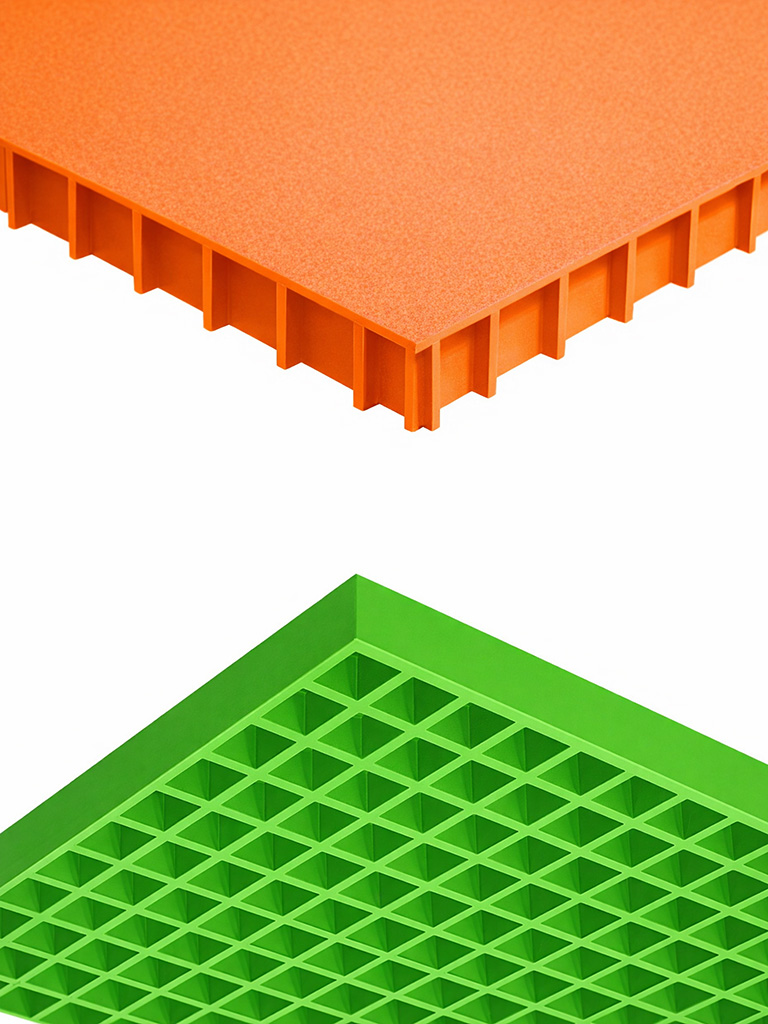
Molded GRP/FRP gratings are the benchmark solution for industrial floors, platforms, and walkways in demanding environments. Manufactured using a continuous open molding process, they combine glass fibers and thermosetting resins to create a strong, slip-resistant, and durable one-piece structure. With a glass content of 35%, they offer excellent mechanical resistance and are available in a variety of surfaces and colors to suit every need.
Pultruded GRP/FRP gratings are a high-end structural solution, offering superior mechanical resistance and durability. Manufactured using a pultrusion process, they combine continuous glass fibers and resins to create I- or T-profiles, which are then assembled into rigid gratings. This design ensures high load-bearing capacity and increased rigidity, while retaining the advantages of composites: lightness, corrosion resistance, and electrical non-conductivity.
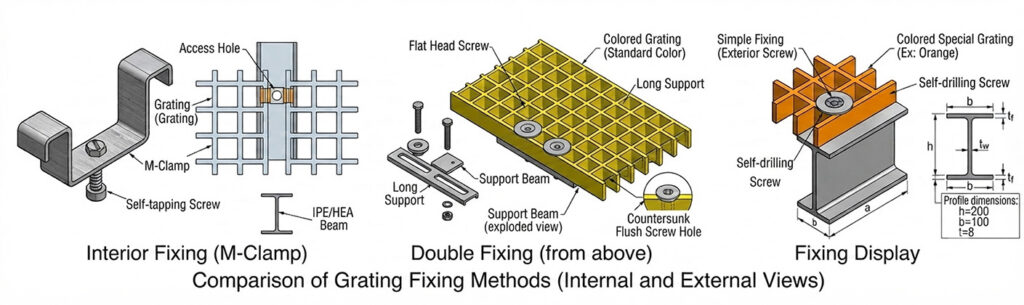
Our range includes: Standard grating with anti-slip surface, Heavy duty grating for high loads, Micro mesh grating for protection against falling objects, Covered grating (solid top) for flat surfaces, and complementary fixing accessories, Standard pultruded grating (I-beam bars), Heavy duty pultruded grating (reinforced section), Individual span bars, Cross bars, and complete fixing kits with M clips, double clips and brackets.
Parameter | FRP Gratings (AERON) | Perforated Steel Sheet | Steel Gratings |
Service life | High | Moderate | High |
Strength-to-weight ratio | High | Low | Low |
Life cycle cost | Low | High | High |
Corrosion resistance | Very high | Moderate | High |
Chemical resistance | High | High | Moderate |
Electrical conductivity | Low | High | High |
EMI/RFI transparency | High | None | None |
Installation cost | Low | Moderate | Moderate |
Handling | Very easy | Difficult | Difficult |
Size | Top Flange Thickness (P1 L) | Connector Thickness (C) | Standard Thickness |
1-1/2 x 1/2 | 2% | 1% | 30 |
1-1/2 x 1 | 2% | 1% | 30 |
1-1/2 x 1-1/2 | 2% | 1% | 30 |
1-1/2 x 2 | 2% | 1% | 30 |
2 x 1/2 | 2% | 1% | 50 & 60 |
2 x 1 | 2% | 1% | 50 & 60 |
2 x 1-1/2 | 2% | 1% | 50 & 60 |
2 x 2 | 2% | 1% | 50 & 60 |
Product Code | Height (mm) | Mesh Size (mm) | Grid Thickness (mm) | Open Area (%) | Sheet Size (mm) |
SM 25 x 38 (x 38) | 25 | 38 x 38 | 7.5 | 69 | 3660 x 1220 |
SM 38 x 38 (x 38) | 38 | 38 x 38 | 7.5 | 68 | 3660 x 1220 |
MM 30 x 20 (x 20) | 30 | 20 x 20 (Min) | 7.5 | 42 | 2000 x 740 |
SM 50 x 50 (x 50) | 50 | 50 x 50 | 8.5 | 71 | 3660 x 1220 |
SM 50 x 100 (x 100) | 50 | 50 x 100 | 6.35 | 68 | 3660 x 1220 |
Contact us today to discuss your project and discover how our PRV/GRP solutions can transform your infrastructure.
At MJS NEGOCE, we understand that choosing composite materials for your projects can raise many questions. To best support you, we have compiled answers to the most frequently asked questions from our clients. This section is designed to provide you with clear and transparent information about our GRP/FRP products, our lead times, warranties, and technical support. Our goal is to eliminate any uncertainty and allow you to make confident decisions, knowing you are working with a reliable and experienced partner.
What are your delivery times? Far far away, behind the word mountains, far from the countries Vokalia and Consonantia, there live the blind texts. Separated they live in Bookmarksgrove right at the coast
Yes. All our GRP/PRV composites are certified according to ISO and ASTM standards. Each batch is audited and inspected before shipment. We guarantee complete traceability of raw materials and strict compliance with manufacturing standards.
Unlike steel, wood, or aluminum, our composites offer:
Yes. We don't just sell materials. Our team supports each client with:
Absolutely. Our composites are designed to withstand the most demanding environments:
We work with a wide range of clients: