
Steel offers good mechanical strength but suffers from severe corrosion in humid, chemical, or marine environments. Rust progressively weakens the reinforcement, reducing structural capacity and requiring costly maintenance such as galvanization or painting. Its heavy weight increases loads on structures and complicates installation. Moreover, steel is electrically and thermally conductive, which can create safety risks in certain applications.
Wood has historically been used in construction, but it is highly vulnerable to moisture, insects, and fungi. This degradation leads to reduced mechanical strength and short service life, often limited to 10–20 years in aggressive environments. To delay deterioration, wood requires toxic chemical treatments, which raise environmental and health concerns. Its flammability also represents a major safety risk in industrial or high‑temperature conditions.
Concrete is heavy, rigid, and prone to cracking or spalling over time. These defects are difficult and costly to repair, especially in corrosive or freeze‑thaw environments. Its excessive weight increases transportation and installation costs, while limiting design flexibility. Although widely used, traditional reinforced concrete structures often face reduced durability and higher life‑cycle costs compared to modern composite alternatives.
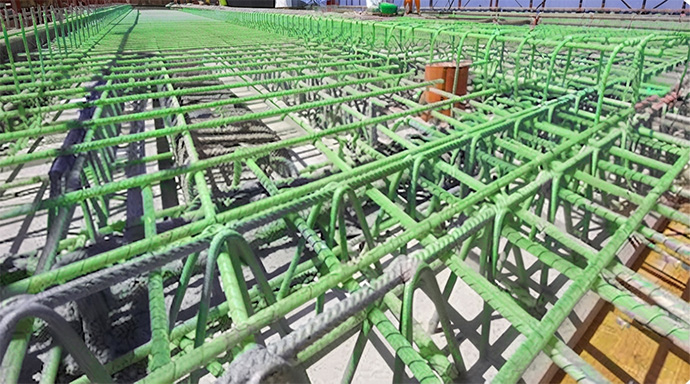
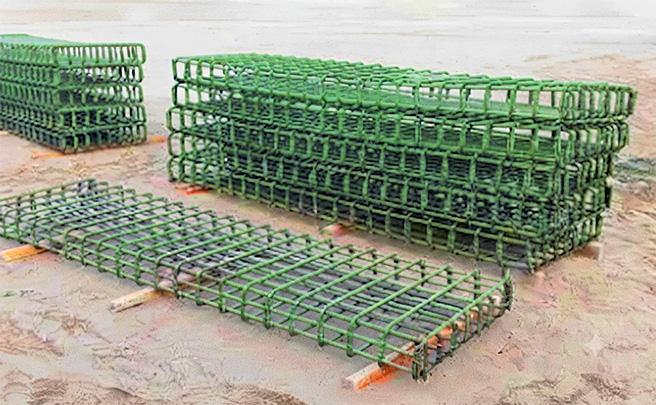
Fiber Reinforced Plastic (FRP) reinforcing bars represent a new generation of reinforcement solutions for reinforced concrete. Unlike traditional steel reinforcement, they are manufactured using advanced processes such as pultrusion or filament winding, where continuous glass or carbon fibers are impregnated with thermosetting resins (polyester, vinyl ester, epoxy). This industrial process ensures perfect homogeneity and high mechanical strength.
Their design results in lightweight, corrosion-resistant, and non-conductive structural profiles that meet the requirements of the most aggressive environments: coastal areas, marine infrastructure, underground structures, and chemical plants. Thanks to their optimized modulus of elasticity, FRP bars reduce the risk of concrete cracking while offering excellent tensile and fatigue resistance.
Property | Steel / Wood / Concrete | FRP Rebars | Advantage |
Corrosion | Rust / rotting / cracking | Total immunity | FRP |
Electrical conductivity | Conductive | Non?conductive | FRP |
Weight | Heavy | 75% lighter | FRP |
Maintenance | Regular | Almost none | FRP |
Service life | 15-25 years | 50+ years | FRP |
Chemical resistance | Low | Excellent | FRP |
Fire resistance | Limited | Fire?retardant options | FRP |
Life cycle cost | High | Reduced | FRP |
Property | FRP Value | Remark |
Density | 1,750 - 2,100 kg/m³ | 75% lighter than steel |
Tensile strength | 600-1,400 MPa (depending on fiber) | Superior to steel |
Elastic modulus | 17-50 GPa | More flexible, deflection control |
Fatigue resistance | ~420,000 cycles | 20x higher than steel |
Thermal conductivity | Low (insulator) | Reduced condensation |
Electrical conductivity | Non?conductive | Electrical safety |
Chemical resistance | Excellent (acids, alkalis, solvents) | Total immunity |
Fire resistance | ASTM E84 Class 1 (optional) | Retardants available |
Service life (corrosive) | 50+ years | Minimal maintenance |
Contact us today to discuss your project and discover how our PRV/GRP solutions can transform your infrastructure.
At MJS NEGOCE, we understand that choosing composite materials for your projects can raise many questions. To best support you, we have compiled answers to the most frequently asked questions from our clients. This section is designed to provide you with clear and transparent information about our GRP/FRP products, our lead times, warranties, and technical support. Our goal is to eliminate any uncertainty and allow you to make confident decisions, knowing you are working with a reliable and experienced partner.
What are your delivery times? Far far away, behind the word mountains, far from the countries Vokalia and Consonantia, there live the blind texts. Separated they live in Bookmarksgrove right at the coast
Yes. All our GRP/PRV composites are certified according to ISO and ASTM standards. Each batch is audited and inspected before shipment. We guarantee complete traceability of raw materials and strict compliance with manufacturing standards.
Unlike steel, wood, or aluminum, our composites offer:
Yes. We don't just sell materials. Our team supports each client with:
Absolutely. Our composites are designed to withstand the most demanding environments:
We work with a wide range of clients: