
Steel offers good mechanical strength, but it is highly conductive, creating significant risks of short circuits and electrocution in the event of insulator failure. Steel poles and crossbeams rust rapidly in humid, coastal, or industrial environments, requiring costly treatments (galvanizing, painting) and regular maintenance. Their weight complicates installation, increases loads on the poles, and makes handling more difficult. Steel also conducts heat, which can degrade insulators and adjacent cables.
Wood, the traditional material for power lines, suffers from serious limitations in the face of moisture, insects, and fungi. This degradation, combined with de-icing salt deposits, promotes electrical arcing that can cause pole fires. Its mechanical strength is low, which limits the spans and loads it can support. Wooden poles and crossbeams require toxic chemical treatments (creosote, CCA), and their lifespan is limited to 10–20 years, or even less in harsh environments.
Concrete is heavy, brittle, and difficult to repair. Concrete posts and beams require reinforced foundations to support their weight. They are susceptible to frost damage and spalling, and repairing cracks is complex and expensive. Their aesthetic appeal is limited, and customizing their shapes is difficult. Excessive weight increases transportation, handling, and installation costs, reducing their attractiveness in modern projects.
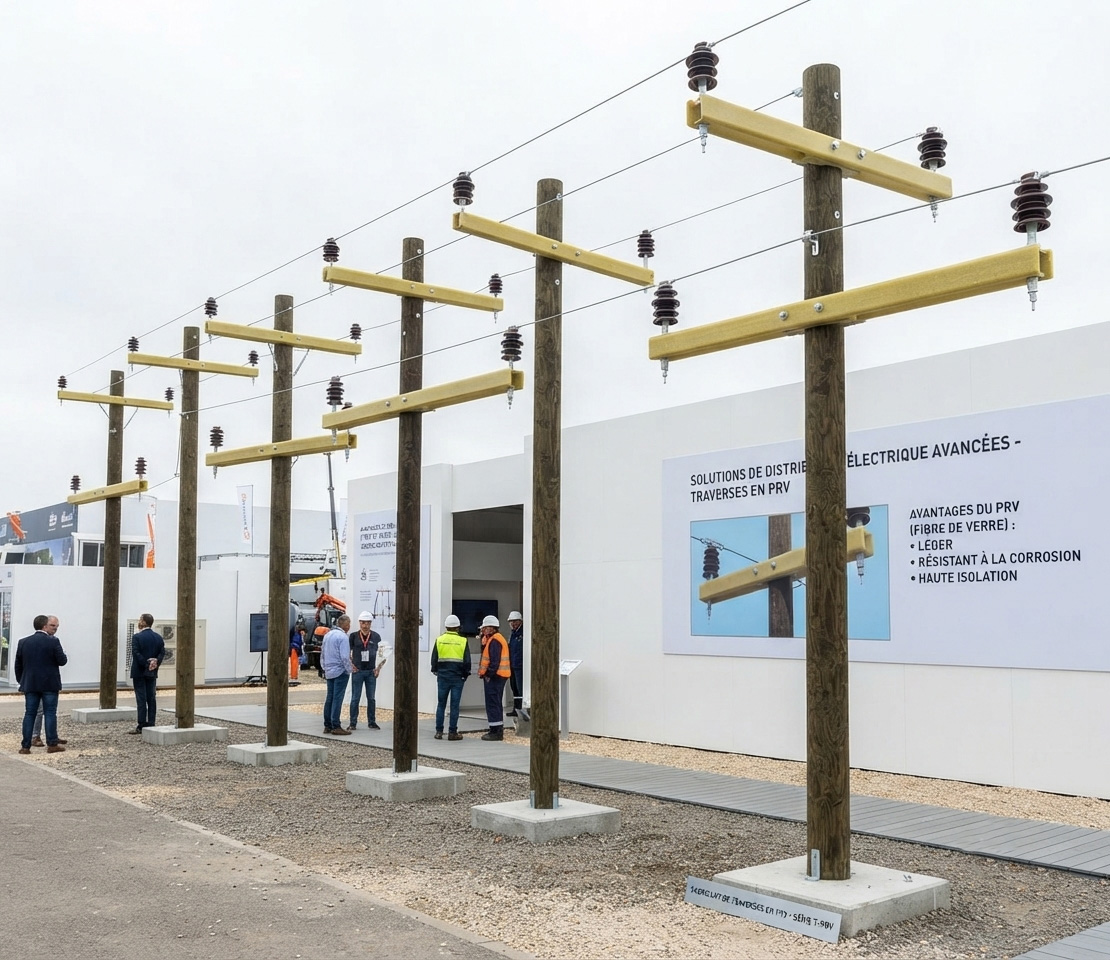
GRP (Glass Reinforced Plastic) sleepers and poles represent a major innovation for modern electrical infrastructure. Manufactured by pultrusion or filament winding, these components combine electrical-grade glass fibers (E-Glass) with thermosetting resins (polyester, vinyl ester, epoxy). The result: lightweight, ultra-strong, and completely non-conductive structures, ideal for ensuring network safety. Used since the 1950s (first installations in Hawaii), GRP poles and sleepers have proven their reliability on lines up to 345 kV. Their resistance to corrosion, UV radiation, and harsh environments ensures a lifespan of over 50 years with virtually no maintenance.
Our product range includes: sleepers for lines < 11 kV, sleepers for lines 11-33 kV, sleepers for lines > 33 kV, and portrains (sleeper supports), with standard and custom configurations. All products comply with NESC and ASTM D8019 standards and are RUS (Rural Utilities Service) approved.
Property | Wood / Steel / Concrete | FRP | Advantage |
Insulation | Wood: poor conductor / Steel: conductive / Concrete: poor insulator | Non-conductive, high dielectric rigidity | FRP |
Corrosion | Wood: rotting / Steel: rust / Concrete: spalling | Total immunity | FRP |
Weight | Heavy (steel/concrete) / Medium (treated wood) | 2-10x lighter | FRP |
Installation | Heavy equipment / foundations | Manual handling / easy | FRP |
Tensile strength | Wood: 7.5 ksi / Steel: high / Concrete: low | 100 ksi (>10x wood) | FRP |
Maintenance | Regular (painting, treatment, replacement) | Almost none | FRP |
Fire resistance | Wood: flammable / Steel: loses strength at heat | Fire-retardant options, reduced pole-top fire | FRP |
Termite resistance | Wood: attacked / Steel & concrete: immune | Total immunity | FRP |
Environmental impact | Wood: toxic treatments / Steel: galvanization | Inert, no leaching | FRP |
Service life | 10-25 years | 50+ years | FRP |
Life cycle cost | High (frequent replacements) | Reduced | FRP |
Specification | Crossarms < 11 kV | Crossarms 11-33 kV | Crossarms > 33 kV |
FRP section used | 40-75 mm (square section) | 55-110 mm (square section) | 55-110 mm (square section) |
Length | 1150 mm (IEC specification) | 1600 mm (IEC specification) | 2580 mm (IEC specification) |
Bolt holes (center axis) | 16 mm, spaced 200 mm | 16 mm, spaced 175 mm | 16 mm, spaced 200 mm |
Insulator holes | 22 mm, spaced 1070 mm (IEC compliant) | 22 mm, spaced 1325 mm (center axis) | 26 mm, spaced 1525 mm (center axis) |
Mechanical strength | IEC specs X/Y directions: 3500 & 100 kg | IEC specs X/Y directions: 4000 & 125 kg | IEC specs X/Y directions: 4000 & 125 kg |
Portrain / support | 40-75 mm square section, length 255 mm | 55-110 mm square section, length 280 mm | 55-110 mm square section, length 280 mm |
Bolt holes (portrain) | 16 mm, spaced 175 mm (center axis) | 16 mm, spaced 200 mm (center axis) | 16 mm, spaced 200 mm (center axis) |
Insulator holes (portrain) | 22 mm, spaced 1070 mm (center axis) | 22 mm, spaced 1325 mm (center axis) | 26 mm, spaced 1525 mm (center axis) |
Contact us today to discuss your project and discover how our PRV/GRP solutions can transform your infrastructure.
At MJS NEGOCE, we understand that choosing composite materials for your projects can raise many questions. To best support you, we have compiled answers to the most frequently asked questions from our clients. This section is designed to provide you with clear and transparent information about our GRP/FRP products, our lead times, warranties, and technical support. Our goal is to eliminate any uncertainty and allow you to make confident decisions, knowing you are working with a reliable and experienced partner.
What are your delivery times? Far far away, behind the word mountains, far from the countries Vokalia and Consonantia, there live the blind texts. Separated they live in Bookmarksgrove right at the coast
Yes. All our GRP/PRV composites are certified according to ISO and ASTM standards. Each batch is audited and inspected before shipment. We guarantee complete traceability of raw materials and strict compliance with manufacturing standards.
Unlike steel, wood, or aluminum, our composites offer:
Yes. We don't just sell materials. Our team supports each client with:
Absolutely. Our composites are designed to withstand the most demanding environments:
We work with a wide range of clients:
Chez MJS NEGOCE, nous savons que choisir des matériaux composites pour vos projets peut soulever de nombreuses interrogations. Afin de vous accompagner au mieux, nous avons regroupé ici les réponses aux questions les plus courantes que nos clients nous posent. Cette section est conçue pour vous apporter une information claire et transparente sur nos produits PRV/GRP, nos délais, nos garanties et notre accompagnement technique. Notre objectif est de lever toute incertitude et de vous permettre de prendre vos décisions en toute confiance, avec la certitude de travailler avec un partenaire fiable et expérimenté.
Nos délais dépendent de la zone géographique et du type de produit commandé. Grâce à notre supply chain internationale et nos partenariats en Inde et au Canada, nous assurons des livraisons rapides et fiables. Pour les projets en Afrique, nous proposons des solutions logistiques optimisées afin de réduire les temps d’attente et garantir la disponibilité des matériaux au moment critique du chantier.
Oui. Tous nos composites PRV/GRP sont certifiés selon les standards ISO et ASTM. Chaque lot est audité et contrôlé avant expédition. Nous garantissons une traçabilité complète des matières premières et une conformité stricte aux normes de fabrication.
Contrairement à l’acier, au bois ou à l’aluminium, nos composites offrent :
Une résistance totale à la corrosion (idéal en zones côtières ou industrielles).
Une légèreté exceptionnelle (75 % plus léger que l’acier).
Une durée de vie supérieure à 50 ans avec une maintenance quasi nulle.
Une sécurité accrue grâce à leur non‑conductivité électrique et thermique.
Oui. Nous ne nous contentons pas de vendre des matériaux. Notre équipe accompagne chaque client dans :
Le choix du produit le plus adapté.
Le dimensionnement technique.
La logistique internationale (incoterms, douanes, transport).
Le suivi post‑livraison et la formation à la mise en œuvre.
Absolument. Nos composites sont conçus pour résister aux environnements les plus exigeants :
Milieux côtiers : résistance à l’eau salée et aux embruns.
Usines chimiques : immunité face aux acides et solvants.
Zones humides : durabilité sans pourriture ni corrosion.
Exposition solaire : protection intégrée contre les UV.
Nous travaillons avec une large gamme de clients :
Entrepreneurs et sociétés de construction.
Bureaux d’études et ingénieurs.
Organismes publics et ONG.
Investisseurs privés qui souhaitent des solutions durables et compétitives.